
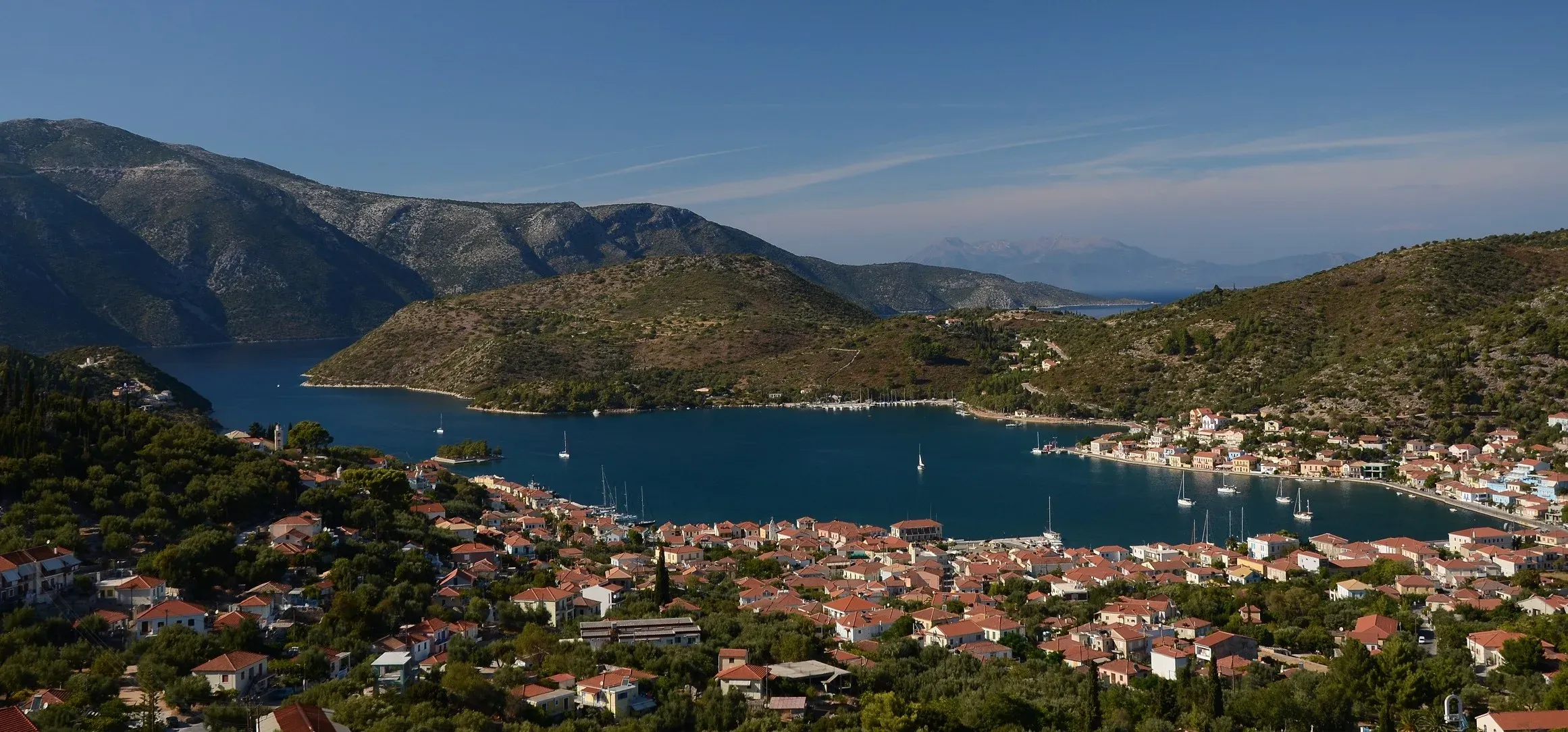
These are the top Ithaca sights, from Homeric caves and ancient acropolises to traditional villages, Byzantine churches and monasteries. Most of them are a short drive from Vathy.
Villages, Caves and Ancient Ithaca Sights
Cave of Loizos
A centre of worship of the proto-Hellenic culture, in the bay of Polis near Stavros, where an ancient sunken city lies. The finds from the excavations in the Cave of Loizos, which later collapsed, clearly show that this harbour was in use from the early Mycenaean period to Greek and Roman times.
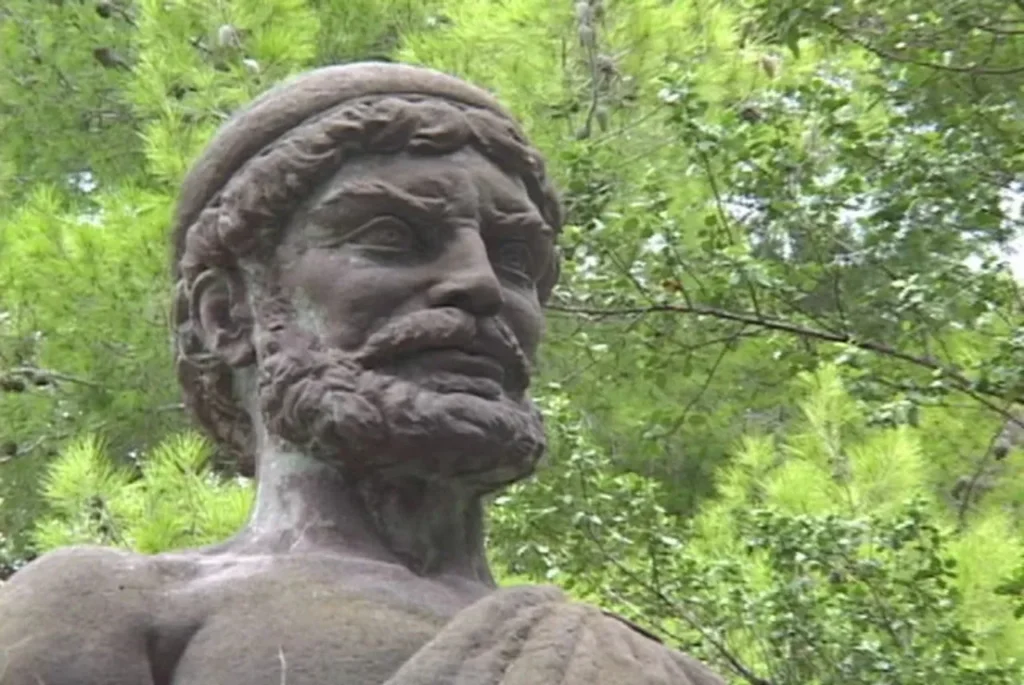
Bust of Odysseus
Read the ‘Prayer of Odysseus’ at the bust of Odysseus, in the park on the square of the village of Stavros.
Anogi – Church of the Dormition
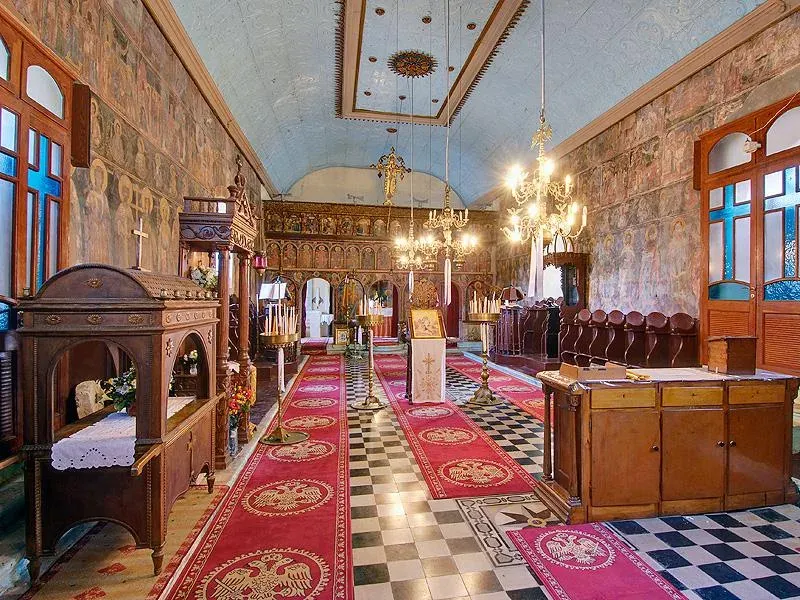
The jewel of the village of Anogi: a church built in the 12th century, with magnificent frescoes and a Venetian-style bell tower.
Anogi – The Menhirs
Huge boulders called ‘menhirs’ are scattered around the village of Anogi.
Araklis is the most important and most curious of these strangely shaped stone blocks. The huge monolith stands just below the houses of the village. It is 9 m high and rests on a rock that is wider than its base.
Its shape is tapered, with eroded surfaces on the east and west sides. Grooves caused by erosion run up the rock, especially on its northern side, ending in a sharp point. The stone is so regular that at first sight it looks like an obelisk shaped by man rather than a natural rock that took this curious form through erosion.
Another remarkable boulder is Kavellaris, named so because it looks like a horseman.
Kioni
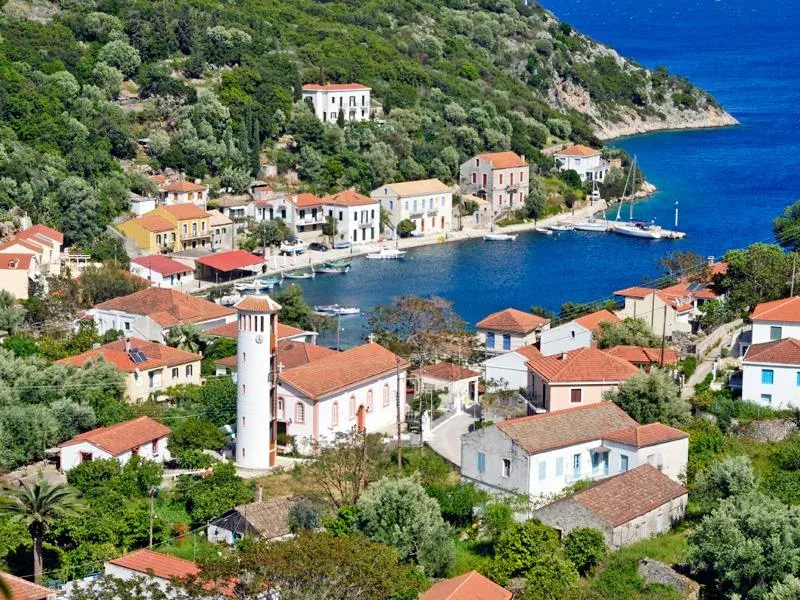
Kioni is a traditional Ionian village with a picturesque harbour where dozens of yachts moor in summer. Once a refuge and base for pirates, the entrance to its bay is decorated by three ruined windmills.
House of Karaiskakis
In Kioni, on the right side of the harbour, a small part survives of the stone house where Georgios Karaiskakis, hero of the 1821 revolution, lived until the revolution.
Vathy
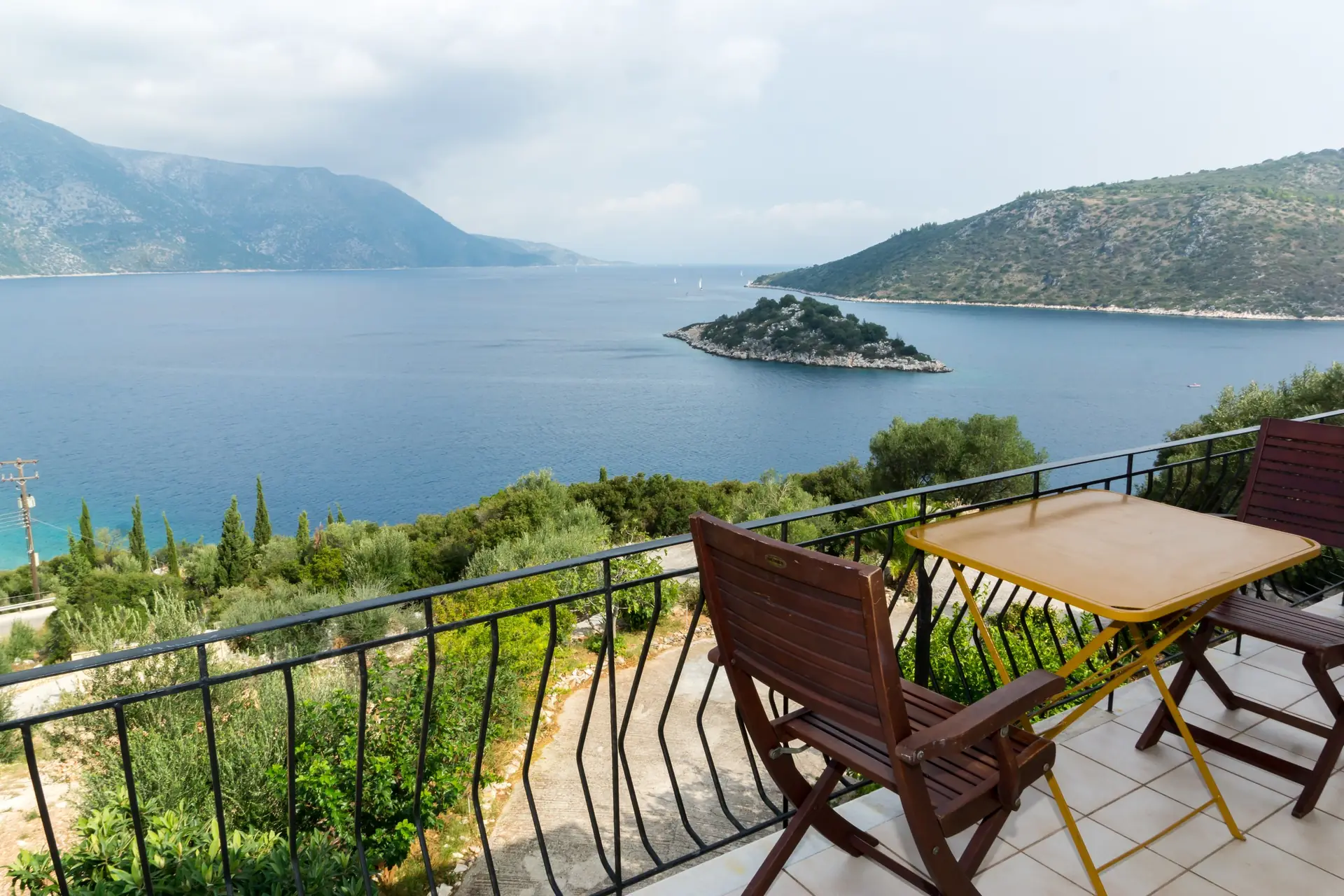
Vathy is the capital of the island. The whole town is a monument, as it preserves its old Ionian architecture and was declared a traditional settlement in 1982. Its beautiful natural bay embraces the islet of Lazaretto.
Cave of the Nymphs
The cave, also known as ‘Marmarospilia’, has two entrances, one for the gods and one for mortals, and wonderful stalactites. According to Homer, this is where Odysseus hid the gifts of Alcinous, king of the Phaeacians.
Paleochora
From Perachori a footpath leads to the ruins of medieval Paleochora, where there are churches with wonderful Byzantine frescoes.
Alalkomenes
On top of the hill of Aetos lies the ancient acropolis that locals call the palace of Odysseus. It may be the city of Alalkomenes and the ‘Constitution of the Ithacans’ mentioned by Aristotle.
Pilikata
Near Stavros, at Pilikata, many place the town of Odysseus according to the description of Homer: a spot overlooking three seas and surrounded by three mountains. Here is the Archaeological Museum of Stavros, with finds from the Mycenaean and Corinthian periods.
Ithaca Sights: Churches and Monasteries
Monastery of Kathara
The Holy Monastery of Kathara, a place of pilgrimage and a point of reference for Ithacans all over the world, stands on the south-eastern tip of Mount Neritos of Homer, in a beautiful spot about 600 m above the sea and 15 km from Vathy. The life of the monastery began around 1696.
But the story of the icon of the Virgin is even older, as Father Theodosios Dendrinos writes in the second edition of his book ‘The Monastery of Our Lady of Kathara of Ithaca’: the name ‘Kathara’ comes from the word ‘kathara’, which in the local dialect means the twigs and small shrubs that are cut and burned to clear a piece of land. Since then, the holy icon of the Nativity of the Virgin, miraculously found among the burning shrubs, has been called ‘Kathariotissa’.
According to the tradition that survives today, shepherds from Epirus, persecuted by the Turks and Albanians, left their homeland and came to Ithaca, where they settled on Mount Neritos, at a place called Mazos, opposite the present monastery. Among the few belongings they had brought with them, they realised that the icon of the Nativity of the Virgin was missing.
One night they saw a blinding light at the spot where the church of the monastery stands today. Despite all their searches, they found nothing there. The same thing happened for several nights, so they decided to cut and burn the shrubs and twigs to clear the place and see what would happen. When the fire went out, they found an icon that had not burned: everyone recognised the icon of the Nativity of the Virgin that they had brought from the mainland. On that spot they built a small church to keep it.
According to another version, the name comes from the followers of the Cathars. The archaeologist and author W. Gell writes in his book Geography and Antiquities of Ithaca that the site was dedicated to the god Apollo, while the author Rita Tsintili-Vlisma suggests that before the church there was a pagan temple, probably of the goddess Athena, one of whose epithets was ‘Kathara’.
Just beyond the monastery stands the bell tower, with the chapel of Saints Constantine and Helen on its ground floor. It was destroyed during the years of occupation and above all by the earthquake of 1953, and was later rebuilt. The view from the bell tower is unique: the south of the island, part of the east coast of Kefalonia, the Echinades islands, the west coast of Aetolia-Acarnania and, on clear days, the coasts of the Peloponnese and Zakynthos.
The icon of the Virgin is attributed to Luke the Evangelist and depicts the Nativity of the Mother of God. In early 1993 the monk Theodosios of Ithaca (Elias Vlismas), from the monastery of Nea Skiti on Mount Athos, settled in the monastery. The Kathariotissa is the patron saint and protector of the island and is celebrated every year on 8 September.
Metropolitan Church of the Presentation of the Virgin
The church of the Virgin in Linovrochia was built, as they say, in 1800, in place of a small church that was enlarged for the needs of the parishioners. It has a wonderful fully carved wooden iconostasis, a post-Byzantine work of art from 1793 made by craftsmen from Metsovo, and a large old bell from 1820.
The Church of Anogi
The church of the Panagia in Anogi, built at an altitude of 500 m, is one of the largest and oldest churches in the Balkans. It is a large basilica, 30 m long and about 10 m wide, partly built around 700 years ago. The interior is of great interest, as its walls are entirely covered with Byzantine-style frescoes, and for this reason it has been a listed historic monument since 1959.
The wonderful images of saints and angels show the incomparable talent of the painter Antonios of Agrafa, who worked in the middle of the 17th century and came from the Agrafa school, which kept the Byzantine tradition alive. According to an inscription on the stone of the church, he completed the frescoes in 1680.
The Earthquake of 1953
The church was badly damaged by the devastating earthquake of 1953. Soon afterwards it was restored with the generous support of the Ithacan shipowner Panos Gratsias, and the frescoes were preserved by the conservator Anastasios Kouvelas. His work restored the whole visible surface of the walls, which on the north and south sides of the nave is arranged in five parallel zones.
The Five Biblical Zones
The first zone has purely decorative images.
The second zone, starting from the top of the church, shows a series of full-length saints. Part of this zone, on the west wall opposite the main entrance, recalls at first sight the mosaics of San Vitale in Ravenna and the frescoes of Meteora. Between Saints Constantine and Helen, the painter added a double-barred cross, known today as the Cross of Lorraine, the emblem of General de Gaulle during the Second World War.
The third zone shows male and female saints in decorated medallions, and the fourth zone scenes from the life of the Virgin and the martyrs of the Church. In the fifth and last zone, cut in half by the metal ceiling installed in 1910, the painter depicts scenes from the life of Christ.
Overall, the frescoes follow the mainland style, influenced by the Cretan school and perhaps by the famous mosaics of the Byzantine churches of Ravenna.
The Old Cathedral of the Island
The frescoes are a magnificent Byzantine work that shows the culture of Ithaca one hundred years after the clash between the Cross and the Crescent at the Battle of Lepanto in 1571, when Anogi was the capital of Ithaca and the church of the Panagia was the cathedral of the island.
The Twelve-Door Iconostasis, the Gallery and the Bell Tower
Visitors should notice the wooden twelve-door iconostasis of the period, the clay jars set into the walls for the acoustics of the church, the old stone monuments and the two-storey women’s gallery from which the Divine Liturgy is followed.
Finally, the imposing Venetian bell tower, built of genuine Neritos stone, still stands despite the passing of time. It is the symbol of the village and a place of pilgrimage for the feast of the Dormition, celebrated on 15 August.